

The Evolution of Weather Forecasting: From Ancient Observations to Modern Science
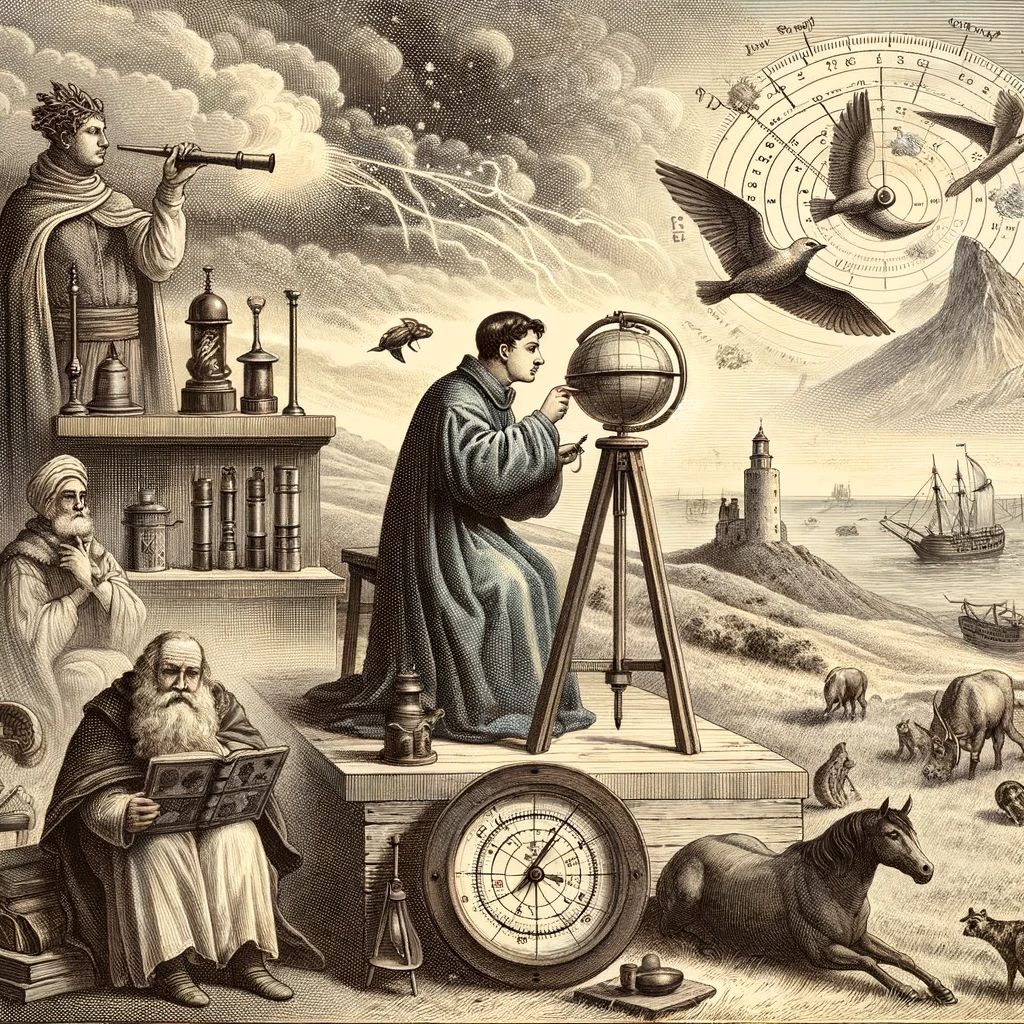
The endeavour to predict the weather, a quest as old as civilization itself, reveals a fascinating journey from observational practices to the sophisticated science of meteorology we know today. This journey spans centuries, cultures, and continents, illustrating humanity’s innate desire to understand and anticipate the forces of nature that so profoundly impact our lives, agriculture, and commerce.
In ancient times, weather forecasting was closely intertwined with astrology. Civilizations such as the Babylonians relied heavily on astronomical events to predict changes in the weather. This method, though rudimentary, laid the groundwork for the systematic observation of the sky, a fundamental principle that underpins modern meteorology.
The Greeks made significant contributions to weather forecasting, with philosophers like Aristotle attempting to understand weather patterns through empirical observation and logical reasoning. His treatise “Meteorologica” explored weather phenomena, although it mixed scientific observations with speculative theories. Nevertheless, Aristotle’s work inspired subsequent generations to study the weather systematically, marking an early step towards distinguishing meteorology from philosophy.
The Renaissance period brought a revolution in scientific thinking and technology, facilitating significant advancements in weather forecasting. The invention of the thermometer by Galileo Galilei and the barometer by Evangelista Torricelli in the 17th century provided the tools to quantitatively measure atmospheric conditions, moving weather prediction into a more empirical and experimental phase.
The late 19th century saw the development of the telegraph, a technological leap that revolutionized weather forecasting by enabling rapid communication of weather observations across vast distances. This innovation led to the establishment of the first meteorological organizations, which began compiling and disseminating weather data, laying the foundation for the national weather services that exist today.
The 20th century witnessed the birth of numerical weather prediction, thanks to advances in mathematics, physics, and the advent of the computer. British mathematician Lewis Fry Richardson pioneered this field, proposing that weather could be predicted by solving mathematical equations that describe the atmosphere’s dynamics. Although his initial efforts were hampered by the sheer computational power required, the development of electronic computers after World War II turned his visionary ideas into practical reality.
Today, weather forecasting is a sophisticated science that combines observations from a global network of satellites, radar, and ground stations with advanced computer models. These models simulate the atmosphere’s behaviour to predict weather patterns days and even weeks in advance with remarkable accuracy.
Climate change poses new challenges and uncertainties to weather forecasting, as traditional models based on historical data may not fully capture the future atmosphere’s dynamics. Meteorologists are continually refining their models to better understand and predict the impacts of a changing climate on weather patterns.
From observing the stars to harnessing the power of supercomputers, the history of weather forecasting is a testament to human curiosity and ingenuity. It’s a story that underscores our perpetual quest to understand the natural world and our place within it. As we look to the future, the evolution of weather forecasting will undoubtedly continue, driven by technological advancements and a deeper understanding of Earth’s complex systems.


