

Voyager 1’s Cosmic Babble: A Beacon of Human Ingenuity in the Silence of Space
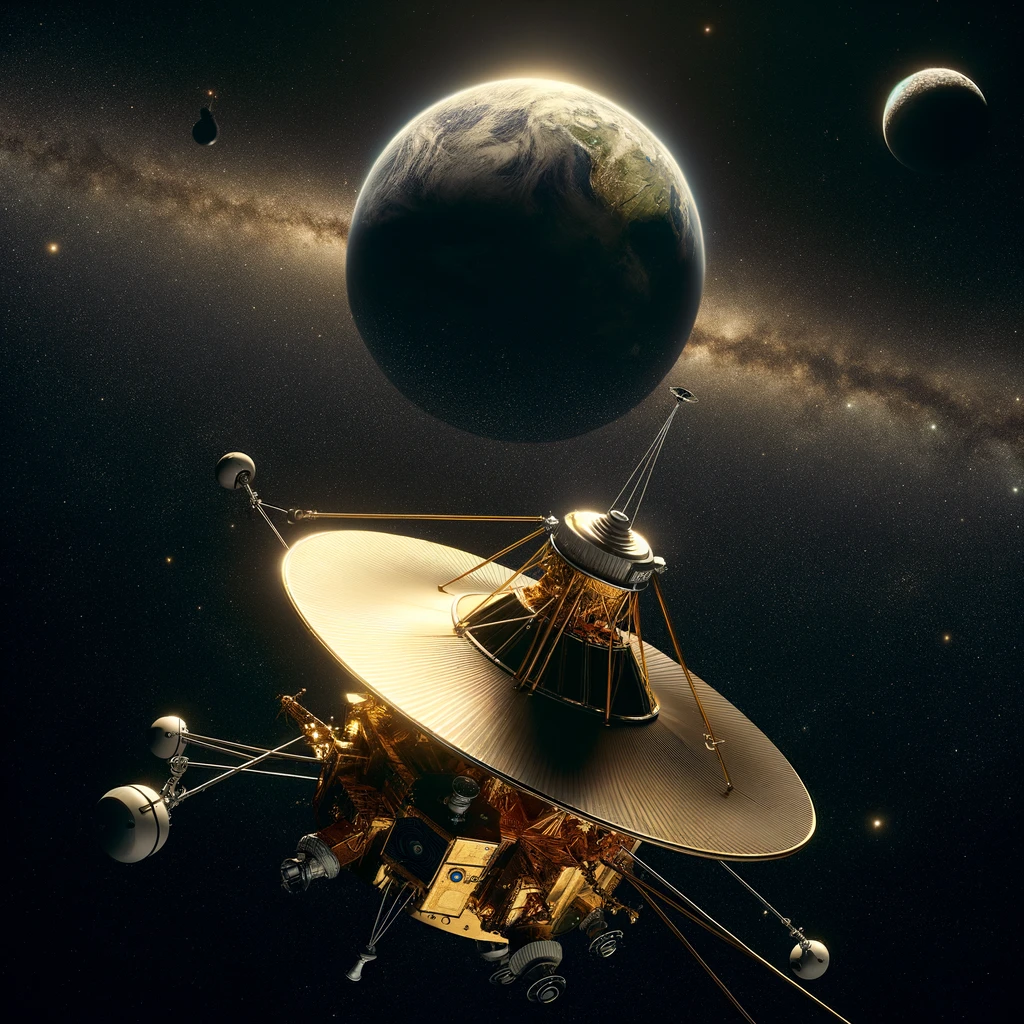
Since November 2023, the vast and silent void of space has echoed with a curious anomaly: NASA’s Voyager 1 spacecraft, a silent sentinel on its journey into the cosmos, began transmitting what can only be described as electronic gibberish back to Earth. The profound mystery of this event has puzzled the brightest minds at NASA, who suspect a cosmic ray may have slightly nudged the spacecraft’s intricate wiring, corrupting just a single bit of data within its Flight Data System. This minuscule change was enough to transform coherent binary transmissions into a meaningless jumble of zeros and ones, presenting a riddle wrapped in the enigma of the infinite darkness.
In an unexpected turn, recent weeks have seen an improvement in Voyager 1’s condition. The spacecraft’s binary output, previously a chaotic stream of data, has begun to exhibit patterns. Though far from the structured language of its intended communications, these patterns suggest the spacecraft’s systems are not entirely lost to the void. Suzanne Dodd, the Voyager program manager, likened the signals to “baby babble” – not fully coherent, yet indicative of a partial system functionality that offers a glimmer of hope to the engineers and scientists eagerly monitoring from millions of miles away.
The tale of Voyager 1, and its twin Voyager 2, is one of remarkable engineering ingenuity and unyielding human curiosity. Launched in 1977, these spacecraft were intended to last just five years, yet here they stand, nearly half a century later, as testaments to human ambition and the desire to reach beyond our known confines. They have survived the harsh realities of space travel, from the relentless bombardment of cosmic rays to the eerie solitude of the outer solar system, largely due to the creative problem-solving of their Earth-bound caretakers.
Bruce Waggoner, a Voyager mission assurance manager, shared with Inverse the ethos that has guided the mission’s engineering team through decades of challenges: the power of thinking outside the box. This approach has been instrumental in navigating the spacecraft through the unforeseen obstacles of deep space exploration. From devising ways to extend the Voyagers’ lifespans by adjusting their power systems to operate on unregulated voltage, to finding innovative solutions for clogged thrusters, the team’s ability to improvise has been key to the mission’s longevity.
The simplicity of the Voyagers’ design is, paradoxically, one of their greatest strengths. With hardware and software that might seem antiquated by today’s standards, these spacecraft are a reminder of a time when simplicity enabled greater understandability and flexibility. The ability to directly interpret and modify the code, without the need for complex simulations, has allowed the Voyager team to troubleshoot issues from billions of miles away. Dodd’s comparison of the Voyagers to an old car, whose mechanics can be directly tinkered with, encapsulates the essence of this advantage.
Yet, as Voyager 1’s current predicament illustrates, the vast distances of space exploration come with unique challenges. Unlike the Mars rovers, which benefit from Earth-based replicas for testing solutions, the Voyager spacecraft are on their own in the dark, save for the ingenuity of their human overseers. The lessons learned from their remarkable journey are invaluable, not just for the continued success of the Voyager mission but for the future of space exploration itself.
As we stand on the precipice of interstellar exploration, the story of Voyager 1 serves as both a cautionary tale and a beacon of hope. It reminds us of the resilience required to venture into the unknown, the necessity of creative problem-solving, and the boundless potential of human curiosity. As Waggoner and his team work to decipher Voyager 1’s binary babble, they do so with the knowledge that each challenge overcome extends our reach into the cosmos, bringing us one step closer to unraveling the mysteries of the universe.
[title]Voyager 1’s Cosmic Babble: A Beacon of Human Ingenuity in the Silence of Space[/title]
[teaser]How has NASA’s Voyager 1, speaking in cosmic gibberish, become a testament to human curiosity and ingenuity in the face of interstellar challenges?[/teaser]
[tags]NASA, Voyager1, space exploration, cosmic rays, interstellar, engineering, problem-solving, spacecraft, technology, science[/tags]
[category]Technology[/category]
[time]5[/time]
[dalle]
Imagine a distant, lonely spacecraft floating in the vastness of space, with Earth far in the background. The spacecraft is adorned with iconic golden records and antennas pointed towards a distant Earth, surrounded by stars and possibly a faint image of a cosmic ray striking it. This image captures the isolation, ingenuity, and fragile connection between humanity and its farthest-reaching ambassador, Voyager 1, as it ventures into the unknown.
[/dalle]
[alt]A spacecraft with golden records and antennas pointed towards Earth, surrounded by stars and a faint cosmic ray in the vastness of space.[/alt]


